SSS Contribution Table for Household Employers and Kasambahays in 2026
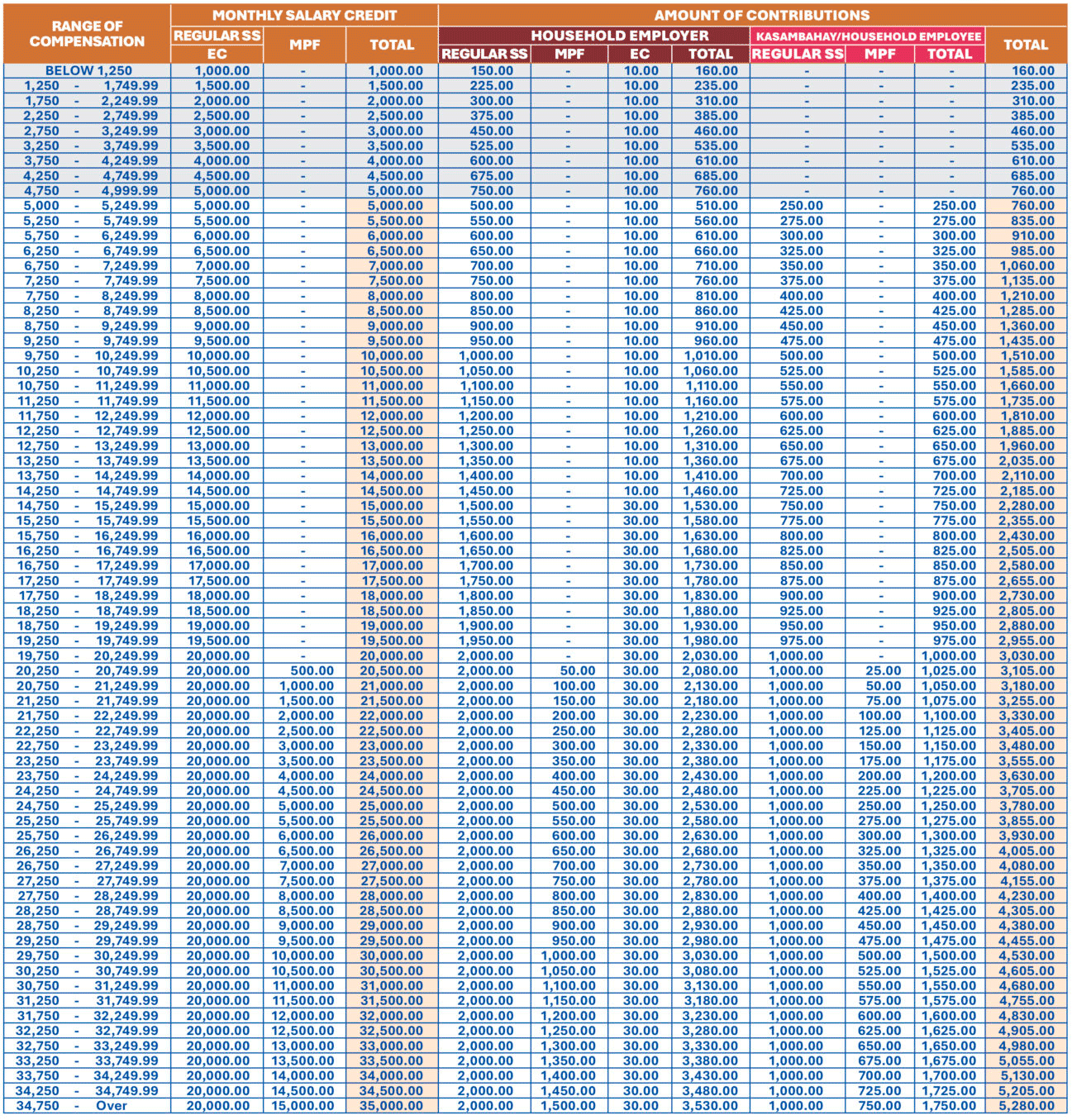
The SSS Contribution Table for Household Employers and Kasambahays provides a comprehensive guide to making contributions to the SSS. The table lists the required contributions for both Household Employers and Kasambahays, effective January 2025. This schedule remains in effect in 2026. It also provides information on the different rates and the different types of contributions that are required.
Related Posts
- SSS Contribution Table for Self Employed
- SSS Contribution Table for OFW
- SSS Contribution Table for Employees and Employers
- SSS Contribution Table for Voluntary and Non-Working Spouses
- Making SSS Contribution Payments Easier Through Partner Channels
- How to Pay SSS Contributions in Bayad Center?
Key Updates for 2025 (Still in Effect in 2026)
According to Circular No. 2024-007, several important changes have been implemented for 2025:
- The contribution rate has been increased to 15%
- The maximum Monthly Salary Credit (MSC) has been set to P35,000.00
- The schedule includes Regular Social Security (SS) Program, Employees’ Compensation (EC) Program, and Mandatory Provident Fund (MPF) Program contributions
SSS has not issued a newer contribution schedule for household employers since then. Circular No. 2024-007, titled “Schedule of SSS Contributions for All Household Employers and Kasambahay/Household Employees Effective January 2025,” is still the latest one, so the same rates and table apply in 2026.
Eligibility Requirements for Household Employers and Kasambahays
A household employer is the person who hires a kasambahay and pays for their services, and a kasambahay is a domestic worker employed directly by a household or a family.
- Household employers are responsible for providing their workers with the necessary benefits and wages that are required by law.
- Under Republic Act No. 10361 (Batas Kasambahay), kasambahays are people who do domestic work for a household within an employment relationship, such as a general househelp, nursemaid or “yaya”, cook, gardener or laundry person. People who do domestic work only occasionally or sporadically are not covered.
SSS coverage of kasambahays is mandatory, and Household Employers and Kasambahays have the following obligations:
Household Employers
- Must have paid employees in the home
- Must register with the SSS as a household employer, either online through My.SSS or by submitting the Household Employer Unified Registration Form (PPS-HEUR1) at any SSS, PhilHealth or Pag-IBIG branch
- Must report each kasambahay to SSS within 30 days from the hiring date
- Must pay SSS contributions by remitting both the employer share and the kasambahay’s share every month, using a Payment Reference Number (PRN)
Under the Batas Kasambahay, the household employer shoulders the contributions. If the kasambahay earns less than P5,000 a month, the employer pays the entire contribution. If the kasambahay earns P5,000 or more a month, the employer deducts the kasambahay’s share from the salary and remits it together with the employer share.
Kasambahays
- Must be employed in the home
- Must register with the SSS and give their SS number to the household employer for reporting
- Must pay their share of SSS contributions (deducted from salary by the employer) if they earn P5,000 or more a month
Registering to My.SSS as a Household Employer
To register as a household employer on the My.SSS platform, follow these streamlined steps:
- Visit the SSS Website: Navigate to www.sss.gov.ph.
- Choose Household Employer: Click “Create a My.SSS account or login”, select “Create account”, and choose “Household Employer”.
- Fill Out the Household Employer Information Form: Complete the required fields, ensuring that all information matches your SSS records, then click “I’m not a robot” and complete the CAPTCHA.
- Submit Your Information: Review your details, accept the Terms of Service, and submit. Check your spam or junk mail folder if you do not receive an email notification from SSS.
- Wait for Email Notification: You will receive an email from SSS containing a link for the next phase of the registration process.
- Fill Out the Household Employer Address Form: Complete the address form, complete the CAPTCHA, accept the Terms of Service, and confirm.
- Activate Your Account: Open the password setup link sent to your email and create your password to gain access to your My.SSS account.
Additional Information
Once registered, you can manage contributions for your household employees and access various SSS services online. It’s important to ensure that all details are accurate to avoid any issues with your registration. If you have further questions or need assistance, consider reaching out to SSS customer service for support.
If you prefer to register in person, submit one filled-out PPS-HEUR1 form at any SSS, PhilHealth or Pag-IBIG branch. This gives you your SSS, PhilHealth and Pag-IBIG employer numbers in one visit. No supporting documents are needed if you file it yourself. A representative needs a Letter of Authorization signed by you.
How to Calculate SSS Contributions for Household Employers and Kasambahays
To calculate SSS contributions for household employers and kasambahays, you will need to know the monthly salary of the kasambahay and refer to the contribution table effective January 2025. The monthly salary of the kasambahay is the total amount that the household employer pays the kasambahay for the services rendered within a month.
The contribution schedule has been updated to reflect the following components:
- Regular Social Security (SS) Program
- Employees’ Compensation (EC) Program
- Mandatory Provident Fund (MPF) Program
The table provides specific contribution amounts based on the Monthly Salary Credit (MSC) range, which now extends up to P35,000.00. Each salary range corresponds to predetermined contribution amounts for both the employer and employee.
For example, if a kasambahay earns P5,000 monthly, you can refer to the contribution table to find the corresponding contribution amounts for both the employer and the kasambahay.
In this example, the MSC is P5,000.00. The household employer pays P510.00 (P500.00 Regular SS plus P10.00 EC), the kasambahay pays P250.00, and the total monthly contribution is P760.00. If the kasambahay earns below P5,000, the table shows no kasambahay share, so the employer pays the whole amount. For example, for a salary of P4,750 to P4,999.99, the employer pays P760.00.
Check your monthly SSS contribution now with SSS Contribution Calculator!
It is important to note that the SSS contributions must be paid by both the household employer and the kasambahay according to their respective shares as shown in the contribution table, except that the household employer pays the entire contribution when the kasambahay earns less than P5,000 a month. The household employer is responsible for remitting the total contribution to SSS, which includes both the employer and employee shares.
Computation of Benefits for 2025 and 2026
According to Circular No. 2024-007, the computation of benefits has been updated with the following guidelines:
- Contributory benefits (retirement, permanent total/partial disability, death, maternity, sickness, unemployment, and funeral) under the Regular SS and EC Programs shall be computed based on the member’s MSC, which ranges from a minimum of P1,000.00 up to the maximum of P35,000.00
- For MSC exceeding P20,000.00 up to P35,000.00, contributions shall be allocated to the MPF Program and credited to the member’s individual account
- Benefits under this program (retirement, permanent total disability, and death) shall be the total accumulated account value consisting of total contributions plus net investment income
Unlike the schedule for business employers, which starts at an MSC of P5,000.00, the household schedule keeps lower salary credits for kasambahays earning below P5,000. The lowest MSC is P1,000.00, for compensation below P1,250.
Benefits of SSS Contribution Table for Household Employers and Kasambahays
The SSS Contribution Table provides several benefits to Household Employers and Kasambahays.
- It allows employers to easily calculate the SSS contribution for their employees. This eliminates the need to manually compute the contribution rate.
- The contribution table helps to ensure that employees receive the correct amount of SSS benefits.
- The contribution table also ensures that employers are contributing the correct amount to the SSS.
- With the updated 2025 rates, it provides better social security coverage with increased contribution ceilings.
You can also check the contribution rates for the other types of monthly contributions with the latest SSS contribution table.
Conclusion
The updated SSS Contribution Table for 2025, which remains in effect in 2026, reflects important changes in contribution rates and maximum Monthly Salary Credit. It continues to serve as an essential tool for Household Employers and Kasambahays, ensuring proper social security coverage and benefits for household employees.
By following the new contribution schedule effective January 2025, employers can ensure that their employees are properly provided for in the event of death, disability, sickness, maternity, and old age, while complying with the latest SSS regulations.
Sss requires to submit monthly contributions thru the USB. What if we don’t own the particular app in the USB
Household employers do not need to submit anything by USB. Contributions for your kasambahay (the employer share plus the employee share, if any) are paid using a Payment Reference Number (PRN) within the prescribed schedule.
You can pay through:
– SSS branches with tellering facilities
– SSS-accredited banks (over the counter, or through the partner bank’s website and mobile app)
– SSS non-bank collecting partners (over the counter)
– Automatic Debit Arrangement
More details: SSS Household Employer page.
Updated on
Our helpers contributions are being paid on my dad’s SSS number which is an employer account. Is that the right way to do it? When I checked the account, there was no record of the name of our helper. How would the helper get claims?
Paying through your dad’s household employer account is the right channel. However, the helper must first be reported to SSS under that account using her own SS number. If her name does not appear in the employer records, she was probably never reported, so the payments may not be credited to her.
What to do:
1. Make sure your helper has her own SS number.
2. Have your dad report her as his kasambahay using the Household Employment Unified Report Form (PPS-HEUR2). New helpers should be reported within 30 days from the hiring date.
3. Visit an SSS branch with the payment receipts and ask them to correct the posting of past contributions to her record.
According to SSS, a kasambahay is still entitled to SSS benefits even if the household employer fails to report or remit. However, the employer can then be held liable for unpaid contributions plus a 2% monthly penalty. More details: SSS Household Employer page.
Updated on
How can I pay the SSS contribution of my sister if she is working from overseas and cannot go to the office abroad? Please assist. Thank you!
If your sister has access to online banking, she can pay her dues through the SSS Online. A family member can also pay on her behalf. To do this, you need to provide the necessary details such as your sister’s payment reference number (PRN) and the amount to be paid.
if i only have 1 kasambahay. do i have to register myself as employer under sss law?
Yes. Even with just one kasambahay, you are a household employer. Under the Batas Kasambahay (RA 10361), a domestic worker who has rendered at least one month of service must be covered by SSS, PhilHealth and Pag-IBIG.
What to do:
1. Register yourself with SSS as a household employer. You can do this online through My.SSS (choose “Household Employer”) or by submitting the Household Employer Unified Registration Form (PPS-HEUR1) at an SSS, PhilHealth or Pag-IBIG branch.
2. Report your kasambahay with their own SS number within 30 days from the hiring date.
3. Pay the contributions every month using a Payment Reference Number (PRN). If your kasambahay earns less than P5,000 a month, you pay the whole contribution.
More details: SSS Household Employer page.